Microsoft Teams, the collaboration app that many of us love to tolerate, has finally rolled out its controversial Wi-Fi-based location-tracking feature — but not without a hefty dose of drama, a delayed launch, and a masterclass in corporate silence. Back in late 2025, the tech world collectively clutched its pearls when reports surfaced that Teams would automatically pinpoint which building an employee was working from by detecting the company's Wi-Fi. The feature, originally slated for December 2025, promised to turn your Chicago-based manager's dreams into your New York office's reality. But wait — wasn't this supposed to be the ultimate return-to-office (RTO) reckoning? And why is Microsoft acting like a teenager who just got caught sneaking out?

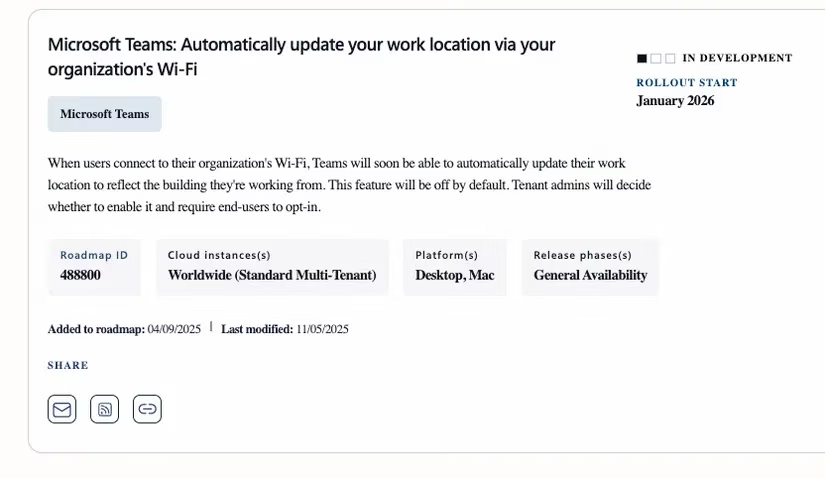
Let's rewind. The original roadmap entry, numbered 488800, read like a dream for micromanagers and a nightmare for anyone who has perfected the art of the strategic Tuesday commute: "When users connect to their organization's Wi-Fi, Teams will automatically set their work location to reflect the building they are working in." Cue the headlines. Forbes snarked, "Just in time for the holidays." Windows Central predicted Teams would become a "lapdog for your boss — automatically snitching on your live location." Mashable, never one to mince words, flatly dubbed it "the new office snitch." Ouch. If there's one thing the internet loves, it's a villain origin story for a productivity app.

But here's the twist: the feature was never the all-seeing eye it was made out to be. According to Cyber Press, the location tracking was disabled by default, requiring IT admins to activate it at the tenant level and end-users to opt in via a consent prompt. So why did the internet react as if Teams had personally volunteered to rat out their remote-work hideaways? Perhaps because the post-COVID work landscape is a powder keg, and any mention of location tracking feels like a lit match. After years of proving that work-from-home setups can be just as productive (and infinitely more comfortable), many employees are still wondering: why go into the office if you've built the ultimate home office? And more importantly, why is your employer so obsessed with where you are?

Microsoft, for its part, seemed to hear the uproar — or at least the PR nightmare. On November 5, 2025, the company quietly updated the roadmap entry. The launch was pushed to January 2026, and the description was rewritten to emphasize that the feature would be off by default and that tenant admins would decide whether to enable it, with end-users required to opt in. But when MakeUseOf asked Microsoft why the change, a representative offered only this gem: "The M365 Roadmap reflects the latest information; otherwise, Microsoft has nothing to share." Nothing to share? Really? A feature that had the internet howling for weeks, and the official response is essentially a shrug emoji? One might ask: is Microsoft being coy, or is it just hoping everyone forgets by the time the feature actually lands?

Now, in 2026, the feature is officially here — and the world hasn't ended. Offices haven't turned into panopticons, and remote workers haven't been dragged back to their cubicles by their Wi-Fi signals. Why? Because the opt-in requirement and default-off setting have neutered the snitch. If your company wants to track your location, it has to jump through hoops: IT admins must enable it, and you must consent. And let's be honest, how many employees are rushing to click "Yes, please track my every move"? Exactly. So while the feature exists, it's more of a philosophical debate than a practical threat. The real question isn't whether Teams can tell your boss you're at home; it's whether your boss's RTO policy is worth the commute. And that's a conversation no Wi-Fi network can solve.
So, what have we learned from this saga? For starters, Microsoft's communication strategy could use a little work. A vague "nothing to share" response to a feature that sparked hundreds of comments across Instagram, Facebook, LinkedIn, and Reddit is hardly reassuring. But maybe the company is playing it smart: by making the feature opt-in and off by default, it's shifting the responsibility to employers. If your company decides to enable location tracking, that's on them — and you'll know about it. If they don't, well, your secret Tuesday work-from-home sessions are safe.
Here's a quick breakdown of the timeline and key details:
| Date | What Happened |
|---|---|
| October 2025 | Roadmap entry 488800 describes automatic location tracking via Wi-Fi |
| Late 2025 | Media frenzy erupts; feature dubbed "the new office snitch" |
| November 5, 2025 | Microsoft updates roadmap: launch delayed to January 2026, feature off by default, opt-in required |
| January 2026 | Feature officially rolls out — quietly |
Will this be the end of the RTO vs. WFH debate? Not even close. But at least employees now have a say in whether their Wi-Fi connection becomes a tattletale. And for office managers dreaming of a full building, the feature's opt-in nature might be a buzzkill. After all, what's the point of a tracking tool if nobody opts in? Perhaps the real lesson is simpler: if you want employees in the office, make the office worth showing up for. Wi-Fi tracking? That's just a tech company's way of reminding us that the workplace is still a work in progress. 😉
This overview is based on IGN, whose reporting often frames how major platform updates and workplace-adjacent tech changes are received by mainstream users. In the context of Microsoft Teams’ Wi-Fi location feature, that broader lens helps underline the gap between alarming first impressions and the more limited reality of an admin-controlled, user-consent-based rollout.
Leave a Comment